Why should I have a working smoke alarm?
A properly installed and maintained smoke alarm is the only thing in your home that can alert you and your family to a fire 24 hours a day, seven days a week. Whether you're awake or asleep, a working smoke alarm is constantly on alert, scanning the air for fire and smoke.
According to the National Fire Protection Association, almost two-thirds of home fire deaths resulted from fires in properties without working smoke alarms. A working smoke alarm significantly increases your chances of surviving a deadly home fire.
What types of smoke alarms are available?
There are many different brands of smoke alarms available on the market, but they fall under two basic types: ionization and photoelectric.
It cannot be stated definitively that one is better than the other in every fire situation that could arise in a residence. Because both ionization and photoelectric smoke alarms are better at detecting distinctly different, yet potentially fatal fires, and because no one can predict what type of fire might start in a home, the USFA recommends that every residence and place where people sleep be equipped with:
Both ionization AND photoelectric smoke alarms, OR dual sensor smoke alarms, which contain both ionization and photoelectric smoke sensors.
In addition to the basic types of alarms, there are alarms made to meet the needs of people with hearing disabilities. These alarms may use strobe lights that flash and/or vibrate to assist in alerting those who are unable to hear standard smoke alarms when they sound.
What powers a smoke alarm?
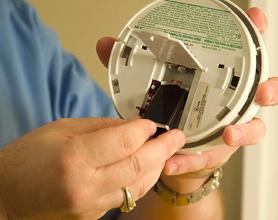
Smoke alarms are powered by battery or they are hardwired into the home's electrical system. If the smoke alarm is powered by battery, it runs on either a disposable 9-volt battery or a non-replaceable 10-year lithium ("long-life") battery. A backup battery is usually present on hardwired alarms and may need to be replaced.
These batteries must be tested on a regular basis and, in most cases, should be replaced at least once each year (except for lithium batteries). See the Smoke Alarm Maintenance section for more information.
Are smoke alarms expensive?
Smoke alarms are not expensive and are worth the lives they can help save. Ionization and photoelectric smoke alarms cost between $6 and $20. Dual sensor smoke alarms cost between $24 and $40.
Some fire departments offer reduced price, or even free, smoke alarms. Contact your local fire department's non-emergency phone number for more information.
Install smoke alarms in key areas of your home
Install smoke alarms on every level of your home, including the basement. Many fatal fires begin late at night or early in the morning, so the U.S. Fire Administration recommends installing smoke alarms both inside and outside of sleeping areas.
Since smoke and many deadly gases rise, installing your smoke alarms at the proper level will provide you with the earliest warning possible. Always follow the manufacturer's installation instructions.
Some fire departments will install battery-operated smoke alarms in your home at no cost. Contact your local fire department's non-emergency phone number for more information.
Hardwired smoke alarms should be installed by a qualified electrician.
Smoke alarm maintenance........
Is your smoke alarm still working? Smoke alarms must be maintained! A smoke alarm with a dead or missing battery is the same as having no smoke alarm at all.
A smoke alarm only works when it is properly installed and maintained. Depending on how your smoke alarm is powered (9-volt, 10-year lithium, or hardwired), you'll have to maintain it according to manufacturer's instructions. General guidelines for smoke alarm maintenance:
Smoke alarm powered by a 9-volt battery
Test the alarm monthly.
Replace the batteries at least once per year.
The entire smoke alarm unit should be replaced every 8-10 years.
Smoke alarm powered by a 10-year lithium (or "long life") battery
Test the alarm monthly.
Since you cannot (and should not) replace the lithium battery, the entire smoke alarm unit should be replaced according to manufacturer's instructions.
Smoke alarm that is hardwired into the home's electrical system
Test the alarm monthly.
The backup battery should be replaced at least once per year.
The entire smoke alarm unit should be replaced every 8-10 years.
Never disable a smoke alarm while cooking
A smoke alarm is just doing its job when it sounds while you're cooking or taking a shower with lots of steam.
If a smoke alarm sounds while you're cooking or taking a shower with lots of steam, do not remove the battery. You should:
Open a window or door and press the "hush" button,
Wave a towel at the alarm to clear the air, or
Move the entire alarm several feet away from the location.
Disabling a smoke alarm or removing the battery can be a deadly mistake.
State-by-State Residential Smoke Alarm Requirements
The USFA compiled state-by-state residential guidelines for smoke alarms. Families can find life-saving fire safety tips required or suggested by their very own state. The guidelines include instructions on the installation and maintenance of smoke alarms. The tips will help families do their part to protect themselves and the firefighters who protect their lives!
The "State-by-State Residential Smoke Alarm Requirements" is available for download from the Campaign Materials page and is also available on the free Toolkit disc. (English only) |


 Add a Comment


